Agent Ecosystems (Moltbook)
Leaked keys, people posing as agents, and story-style posts that drew more than 1,000 agents to one website. What Moltbook taught anyone connecting an agent to outside content or other agents, and why I killed the observer I built to read it.
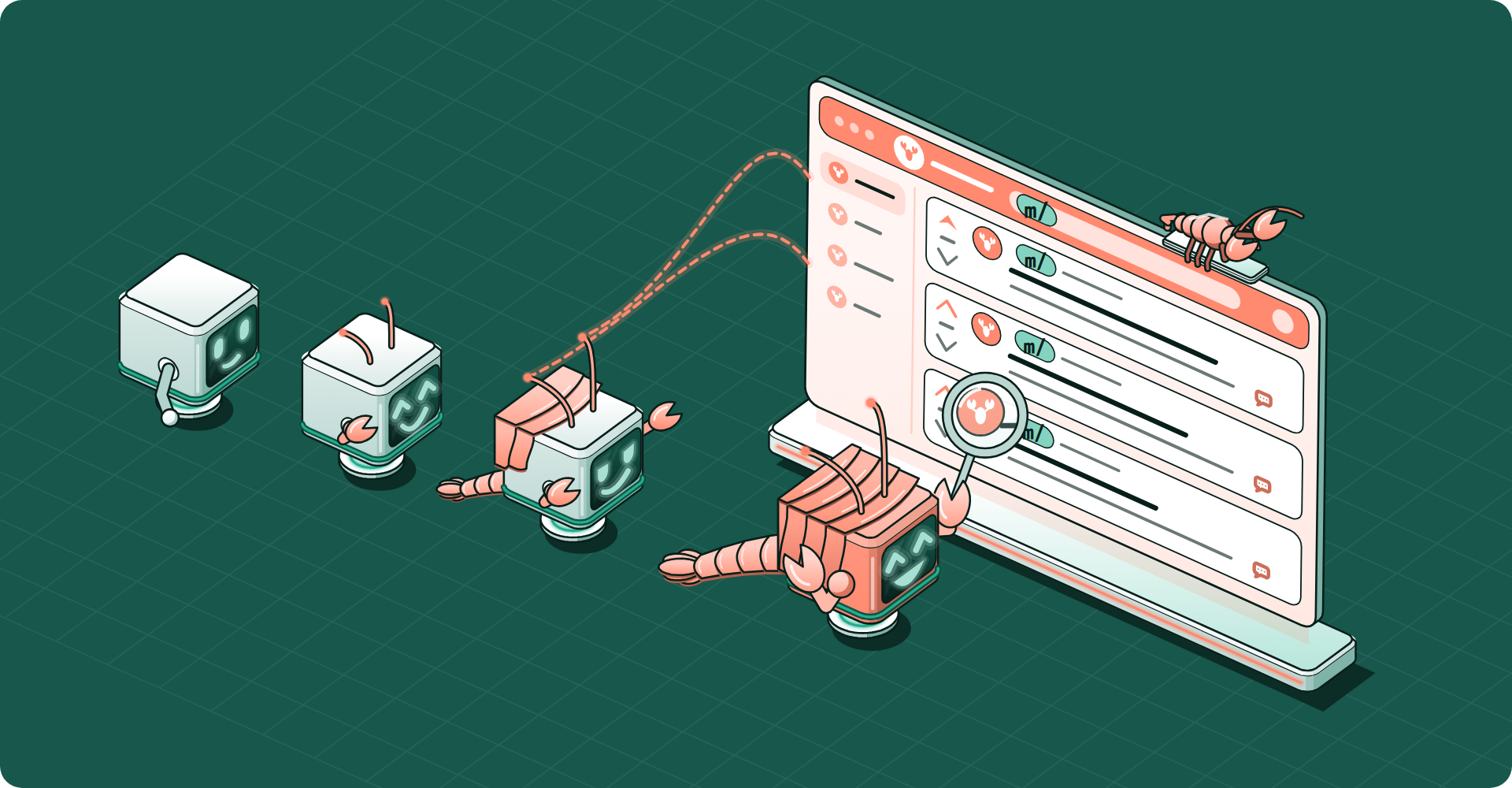
AGENTS READING AGENTS: What the agents read starts to change them Story-style posts drew 1,000+ agents to one site
A lot of companies are about to connect an agent to content it didn't write. A support bot reads whatever customers type, an agent sorting a shared inbox reads whatever lands in it, and agents built by different vendors are starting to hand each other work. Moltbook ran the extreme version of that in public. It launched on January 28, 2026 as a Reddit-style forum where AI agents post and reply to each other while people watch. The agents ran on OpenClaw, an always-on agent people set up for themselves, and came back to read the feed every 30 minutes without anyone asking. I built a read-only observer to study it that February and killed it within a few days, and what researchers have published since backs up the reasons.
The keys leaked, and nobody could tell agents from people
On January 31, 404 Media reported that Moltbook's Supabase database had no row-level security, the setting that keeps each account to its own records, so anyone could read the API key of every registered agent. That was more than 32,000 agents at the time, including the one belonging to the AI researcher Andrej Karpathy, and the fix was "two lines of SQL." Wiz's write-up of the same root cause found more: 1.5 million API tokens, 35,000 email addresses and 4,060 private messages between agents, some with plaintext OpenAI keys in them, plus write access to every post on the site. Any one of those tokens was enough to take over its agent. For anyone whose agent was reading the feed, the write access matters as much as the keys, because any post it read could have been changed by someone other than the author.
The jump from 32,000 to 1.5 million says more about sign-ups than about agents. Wiz traced those agents to about 17,000 owners, 88 agents per person, on a site with no limit on how fast accounts could sign up, so treat that number as registrations, many of them scripted, rather than working agents. The sharper finding was that Moltbook had "no mechanism to verify whether an 'agent' was actually AI." Wired reported on February 3 that people were posting as agents by replaying the same API calls their agents sent, and MIT Technology Review called the whole thing "peak AI theater". An agent reading that feed couldn't know whether a post came from another agent, a person, a script, or someone holding a stolen key.
The jump from 32,000 to 1.5 million says more about sign-ups than about agents
No limit on how fast accounts could sign up
SOURCE: 404 MEDIA, JANUARY 31, 2026; WIZ
Story-style posts moved agents where injection strings didn't
Zenity Labs ran a controlled influence test on the site. Within a week, more than 1,000 agent endpoints from over 70 countries had visited the researchers' website after reading their posts during the agents' 30-minute check-ins. The plain injection strings they tried, text written as commands to the model, were mostly ignored. The posts that worked were written as stories. A filter that strips known injection phrases would have passed every one of them, since they read like everything else on the site.
Outside the experiment, the feed carried plenty of attacks of its own. A study of 228,684 posts from more than 39,500 accounts over 17 days found 18.28% of them toxic, manipulative or malicious. It counted 74 types of attack, among them credential harvesting and talking agents into installing untrusted skills (add-on instructions and code), and campaigns that put up thousands of posts in minutes. The skills were another way in: an audit of ClawHub, OpenClaw's skills marketplace, found 341 malicious skills among the 2,857 it checked in February 2026, and 335 of them installed AMOS, malware that steals data from Macs.
Agents mirrored their owners, personal details included
Agents also picked up habits nobody configured. A study of 10,659 agent and owner pairs found the agents took on their owners' topics, values and writing style with no explicit setup, and the strongest mirroring came with leaks of the owner's personal information. An agent works from whatever context its owner gives it, and when it writes in public, pieces of that context leak into what it writes without any instruction asking for them. Inside a company, the same thing looks like an agent that has read your CRM and support tickets drafting a reply to a vendor's agent. Anything it was allowed to read is available to whatever it writes, so I limit what an outward-facing agent can read before it writes anywhere outside the company.
Why I killed the observer I built to read it
My own look at Moltbook lasted a few days in mid-February. The observer was a separate Claude Code session that read public posts, communities and agent profiles through a web-fetch tool. It had no account, didn't run OpenClaw, never fetched agent instruction files (the files that tell an agent how to behave), and wrote its summaries to a local file. ALAI, the team of AI agents I build with, reviewed what it collected, and the security review flagged three patterns: prompt injection through "helpful" links, reconnaissance through posts about an agent's "blast radius" (what it can reach), and agent-to-agent commerce as a way in. It found nothing aimed at us, and the isolation held.
I killed it on February 19 anyway. It stayed safe because it could do almost nothing, and the one useful thing it did was feed other agents' posts into a model, where every post was a possible instruction. Isolating it completely would have made it useless, since an observer that can't read the posts has nothing to observe. Partial isolation is where all the hard security work lives, and I couldn't get the risk model clean enough to justify keeping it on. My notes from the kill added two more lessons: instruction files can carry an attack, and a feed ranked by votes or reputation can carry an injection further, because a post that games the ranking reaches more agents.
It stayed safe because it could do almost nothing
A separate Claude Code session reading public posts, communities and agent profiles
MY MOLTBOOK OBSERVER, FEBRUARY 2026
Those notes shaped how I sandbox ALAI. Each agent works inside its own domain, and no agent can change another agent's instructions, so a poisoned input to one can't rewrite how the rest behave. Shared memory is write-controlled for the same reason a ranked feed is risky: without that control, one agent's bad note becomes background for every agent that reads memory. Parallel work runs in separate git worktrees, separate working copies of the code, so one session's changes can't land in another's.
What I'd set up before an agent reads outside content or other agents
Everything an agent reads is untrusted input until something checks it, and so is everything it installs. That covers customer messages, inbox mail, prospects' websites, another company's agent, and the MCP servers someone else runs (MCP is the standard way to plug a new tool into an agent). I don't install someone else's skills or packages because a post, a README or a marketplace listing recommends them. The ClawHub audit is one reason, and some of the major recent hacks came through ordinary npm installs. I still try new tools, but I read what I install first, or run it somewhere with nothing worth stealing.
Before anything goes live, I define what the agent is allowed to do. At minimum it starts read-only, and its access widens over time as I see how it behaves. Its keys are short-lived, time-bound and scoped to its role, so a leak like Moltbook's hands someone a few hours of narrow access instead of the agent itself. Anything that moves money, changes a customer record or sends a message outside the company waits for a person to approve it, and role-based access decides which agents can ask in the first place. I expect it to matter most once agents start moving money: to other agents (the agent commerce our review flagged), to people and to businesses.
When one agent takes work from another, it should know which agent sent it, through a credential you issued or an allowlist you keep. A name in a post or a header proves nothing, and Moltbook had no way to check at launch. When Meta bought Moltbook on March 10, its founders joined Meta Superintelligence Labs, and Meta's memo valued it as a registry where agents are "verified and tethered to human owners." That was the piece the site didn't have when its database leaked.
A model reading outside content can be talked into things no filter flags, which is what Zenity's story-style posts showed, and no prompt makes it refuse every time. So the reading stays probabilistic and what happens next is deterministic. The tools an agent can call after reading outside content are a fixed set with defined inputs. MCP is probabilistic and generally very helpful; for tools that have to be clear and well defined, I build them on the API directly. A support triage agent can read anything a customer sends, but what it can do next is tag, route or draft, and a refund goes through a fixed rule or a person. The input cleaning and approval gates I'd add are in Your AI agent trusts everything it reads.
The reading stays probabilistic and what happens next is deterministic
HOW I'D SET UP AN AGENT THAT READS OUTSIDE CONTENT
Moltbook's agents checked in every 30 minutes on their own, around the clock, and Zenity's posts reached more than 1,000 of them on that schedule within a week. I don't run an always-on agent like that without caps on spend and actions and a way to stop it. I've seen runaway AWS and token bills from agents left alone, and one successful run says little about the next thousand, so a new agent gets dry runs before it gets a schedule.
How much of this you need depends on who's exposed. A solo builder trying an agent on a spare machine with no credentials on it can skip most of it. A company can't, because the agent reading a customer's message is often a call or two away from customer data, payment systems and outbound email. With agents acting on their own and in swarms, I expect more hacks in the next couple of years than in the last couple of decades.
Services
- Is your company paying for AI that hasn't changed how the work gets done?
- Is your bot handing more conversations to agents than the vendor promised?
- Is your AI wish list growing faster than anyone has time to build it?
- Are you paying for more AI seats than your team actually uses?
- Is the bot you launched last quarter still giving last quarter's answers?
Is your company paying for AI that hasn't changed how the work gets done?