Now taking AI implementation clients
Where AI usually leaks money and risk inside a company, the rules I build around it, and what each offer costs, starting with a free call and a $5,000 two-week Diagnostic.
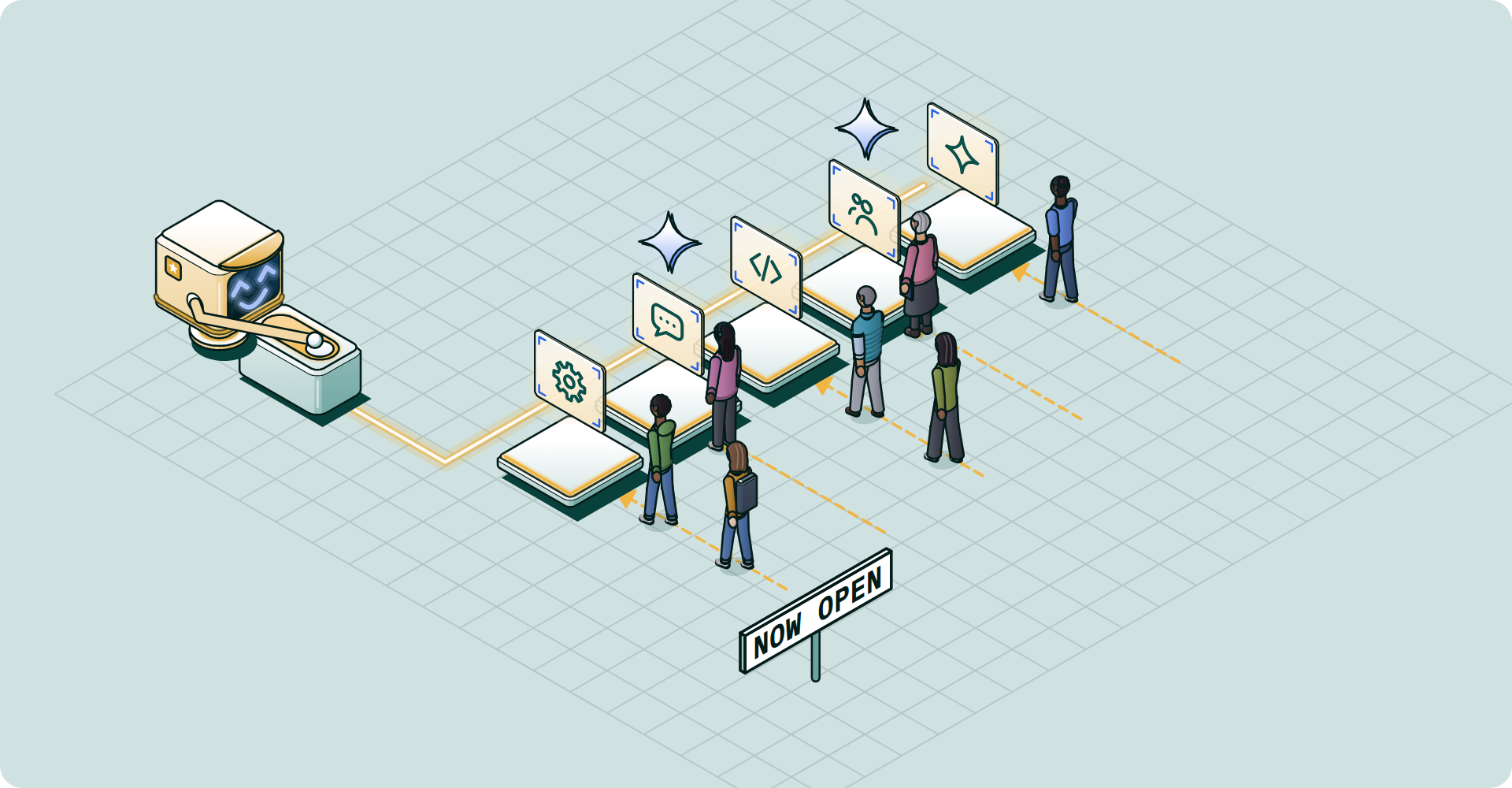
WHAT I BUILD: AI built into tools your teams already use with each person trained to run their part
I help companies get the AI they already pay for to change how their work gets done. I find the steps worth automating, build them inside the tools people already use, teach the team to run them, and hand all of it over. In most companies the tools arrived before anyone decided who owns the bill, what each agent can reach, where it gets its context, or who approves anything it does with money or customer data. In Gallup's AI tracking as of May 2026, only 25% of U.S. employees said their organization had communicated a clear plan for integrating AI. Those undecided parts are where AI leaks money and takes on risk. It happens in every function, from support and engineering to finance, legal and HR, and it's worst in the handoffs between teams, where nobody owns the whole path.
I did this work in-house for three years at Tools for Humanity, the company behind World App, which has more than 40 million users. I owned the help desk, built and managed six AI agents, and ran the support bot's rollout from 5% of live traffic to full cutover. Now I'm taking clients, and I work embedded, forward-deployed style: inside your Slack, help desk and tracker, the way I did in-house. Every offer below has a price on it.
Spend leaks through oversized models, stale context and agents nobody watches
Models are billed by the token, the small chunks of text they read and write, and the gap between tiers is wide. On Anthropic's price list, Opus 5.5 costs 40 times as much per token as Haiku 5.5. If a top-tier model sorts tickets that a cheaper one would sort just as well, that's 40 times the price for the same answers. Which tier is good enough for a job is something you find out by testing it on real work, and the answer can change when a new model ships.
The conversation adds to every call as well. A chat or agent session left open for days fills up with old tool output and stale back-and-forth, which people call context rot, and through an API every new message pays to send the whole pile again. It makes the answers worse, too: in a 2025 study across 18 models, Chroma found that performance consistently drops as the input grows. I split long work by theme into new sessions for both reasons.
Agents that run on their own leak in two more ways. Every call resends the same long block of instructions, and prompt caching bills that repeated block at a discount. On Anthropic's API, though, caching is off until someone turns it on, and the cache expires after five minutes by default, so an agent that wakes every half hour pays full price on every run. The bigger leak is a run nobody is watching. I've seen runaway AWS and token bills from agents left going with no caps, and a dashboard showing how much went out this month says nothing about how fast it's going out right now. I'd cap every unattended agent and alert on how fast its spend is climbing, and when that alert fires, a person checks in with whoever owns the agent, more or less "u good bro?"
Seats leak more quietly. A paid seat that only ever rewrites emails usually means nobody showed its owner what else it can do, and in BCG's 2025 survey of more than 10,600 workers, only 36% felt adequately trained. A seat count, like a token bill, can't tell you whether the money was well spent until it sits next to what it produced: pull requests accepted, features released, revenue, users who come back to a feature. Lines of code don't belong on that list, because an agent can turn out volume all night without shipping anything anyone uses. I've yet to see a company tie its AI spend to outcomes well, and I think it's the key to seeing what the tokens are buying.
People redo what the AI couldn't see or wasn't told
Picture the ticket history in the help desk, the spec in Figma and the decision in a Slack thread nobody linked. The AI can't do the pre-read on any of that, so a person does it by hand before every handoff. Agents belong where the context lives and where people already work, in tools like Slack, Notion, Google Docs, Linear and GitHub, so the agent does the pre-read and people check it in the same place. At Tools for Humanity we connected Notion, Slack, Linear and GitHub. In the work system I set up there, a Slack workflow could tag Linear's agent, which read the team's doc to triage the request, asked for anything missing, and confirmed or changed where it was routed. I think that's why Slack is winning right now: it's where people already talk, and an agent there can pull context from everything else.
Ask five people to get the same customer email out of the same AI, and you'll get five emails that sound like five companies, because each of them asked differently and gave it different context. No setup guarantees the same output from a model, but a shared one massively raises the odds. That shared setup is a harness: the rules, profiles and hooks (checks that block what's off-limits) that everyone's AI tools load, company-wide underneath and tailored by each department on top, with one voice, tone and brand guide running through all of it. Tools for Humanity didn't have one, and I think it should have. I did the part I could on my own: I built internal brand guidelines from World's public brand page, and every public-facing page and artifact I made followed them.
Corrections get lost the same way, one person at a time. When the AI gets something wrong, the quick fix is to correct the output by hand and move on, and next week the same mistake comes back for the next person. The fix belongs where every tool will find it next time: a rule, a saved skill, a memory note or a script in the harness. In a company, anyone can propose one by pull request, the way engineers propose code, and every department's agents pick it up.
Agents can reach more than anyone decided they should
Your employees probably get access by role, through one managed system, and lose it when they leave. An agent on a long-lived token with wide access skips all of that, and if the token is ever stolen, that access is still live when someone notices. In IBM's 2025 breach report, 97% of the organizations that had an AI model or app breached said they had no AI access controls in place. Even MCP, an open protocol for connecting AI agents to tools, lists authorization as optional. I expect more hacks in the next couple of years than in the last couple of decades, because agents now act on their own, around the clock and in swarms.
97% of the organizations that had an AI model or app breached said they had no AI access controls in place
Each tile is one organization in 100.
SOURCE: IBM'S 2025 BREACH REPORT
I'd scope every agent before it ships, read-only at a minimum, and widen its access as the work shows it needs more, so each widening is a decision someone made on purpose. Put agents behind the same managed gateway as everyone else, with access by role, only what the job needs, and short-lived tokens that expire on their own. A solo builder can skip most of this on their own projects, since the data at risk is theirs, but a company's agents touch customer records and colleagues' files. At Tools for Humanity I wrote the support organization's policy for using Claude, Codex and Notion AI safely: model limits, read-only by default, dry runs before any write, and hooks that blocked writes outside a user's role. An agent gateway with role-based access was on the roadmap.
Fixed rules around the model, and a person on money and data
Models are probabilistic. Ask the same question twice and you can get two different answers, so before I build a bot, an automation or an agent, I sort its parts into what has to happen the same way every time and what can vary. In the support bots I build, the model words the answers, and escalation is a rule: a person who asks for a human twice gets one. Money, permissions and any number someone will act on go on the fixed side. Through MCP, the model reads a list of tools and decides which to call and what to pass, which is probabilistic and generally very helpful, especially for looking things up. For a clear, well-defined action like a refund, I build the tool on the system's API directly, so code makes the call with fixed inputs and the model can only ask for it.
Anything that moves money or data, or goes out to customers, waits for a person. An agent can draft a refund, a record deletion or an email to every customer, and then the action sits until a named person on your side approves it. That approval is a check in code, so the agent can't grant it to itself or talk its way past it. How heavy the review is depends on what a mistake costs, which is why a reply quoting your refund policy to a customer gets a closer look than an internal summary.
We agree on the number first, and I leave with no access
Every build gets one number that decides whether it worked, agreed before anything gets built, and you see a demo of the work every week. We also agree on when to read the number, because the timing can change the answer. For a support bot, I'd use containment, the share of conversations the bot finishes without a person, read about a month after cutover. World App's bot hit a 92% peak and settled around 82% after about a month, and the 82% is the one I'd want a client to hold me to.
A rollout starts on a small share of real work, with your team reviewing, and how small that share is and how fast it widens depends on what a wrong answer costs. World App's bot started on 5% of live traffic because every conversation went through a fraud check first and about 40 million people used the app. If a bot serves a handful of high-value customers, I'd go slower still: a day on 5%, then stop, review, fix and turn it back on. A tool that drafts internal meeting notes may not need a ramp at all.
When the work is done, your team gets a walkthrough and a written runbook for everything I built or changed. I remove my admin access and hand back or rotate every key I used, and once the work is paid for, you own what I built for you, with a permanent license to any of my own tools inside it. I'd hold your agents to the same standard, with access that ends when their job does.
How to start, and what each offer costs
Every engagement starts with a free thirty-minute call. You tell me what's stuck, and I tell you whether I'm the right fit and which offer makes sense. If you can't tell which of these leaks is yours, start with the Diagnostic, where I follow one of your workflows end to end before anyone builds anything. The services page has what each offer includes.
-
AI Workflow Diagnostic: $5,000, two calendar weeks from kickoff, about 25 hours (roughly 12 a week) of my time. Start here. I map one workflow end to end and rank the two or three automations worth building, with a build plan for the top pick. Sometimes the answer is "don't build this yet." The full fee comes off the first invoice of a Support AI Agent Launch, Support AI Agent Rebuild, Embedded AI Build, or Fractional AI Lead for Operations signed within 30 days of the readout.
-
Support AI Agent Launch: from $35,000, six to eight weeks. A support bot on the help desk you already pay for, with flows, knowledge, escalation, and fraud routing, rolled out in stages on live traffic. It runs on Zendesk today. On another help desk, I'd need an API key, a map of your setup and of what its API can't reach, and some sample tickets and workflows.
-
Support AI Agent Rebuild: from $20,000, four weeks. For a support bot that's already live. I read a few hundred of its live conversations, redesign it in a sprint, and roll the new version out in stages against the one you have now. If the first week shows it needs replacing, everything you paid at signing comes off a Launch's first invoice.
-
Embedded AI Build: $20,000 a month, planned in three-month blocks. Up to 80 hours a month inside your Slack, help desk, and tracker, building automations your team owns.
-
Team AI Enablement: From $7,500 per cohort. A half-day on your team's real work. Each person leaves with a working AI skill they built, followed by 30 days of office hours. This is the one for seats nobody was shown how to use.
-
Fractional AI Lead for Operations: $7,500 a month, planned in three-month blocks. Up to 30 hours a month owning your AI tools after launch, covering tuning, QA, vendor reviews, and a monthly readout.
To start, book a free thirty-minute call. Bring the workflow that eats the most hours, or the AI bill nobody can explain, and we'll work out which leak to fix first.
Services
- Is your company paying for AI that hasn't changed how the work gets done?
- Is your bot handing more conversations to agents than the vendor promised?
- Is your AI wish list growing faster than anyone has time to build it?
- Are you paying for more AI seats than your team actually uses?
- Is the bot you launched last quarter still giving last quarter's answers?
Is your company paying for AI that hasn't changed how the work gets done?