Why World App's support bot started on 5% of live traffic
How a three-way split on live traffic and a redesign sprint took World App's support bot from the old bot's 55% containment to a stable 82%, plus the escalation rules that keep that number honest and how I'd size the first slice of any AI rollout.
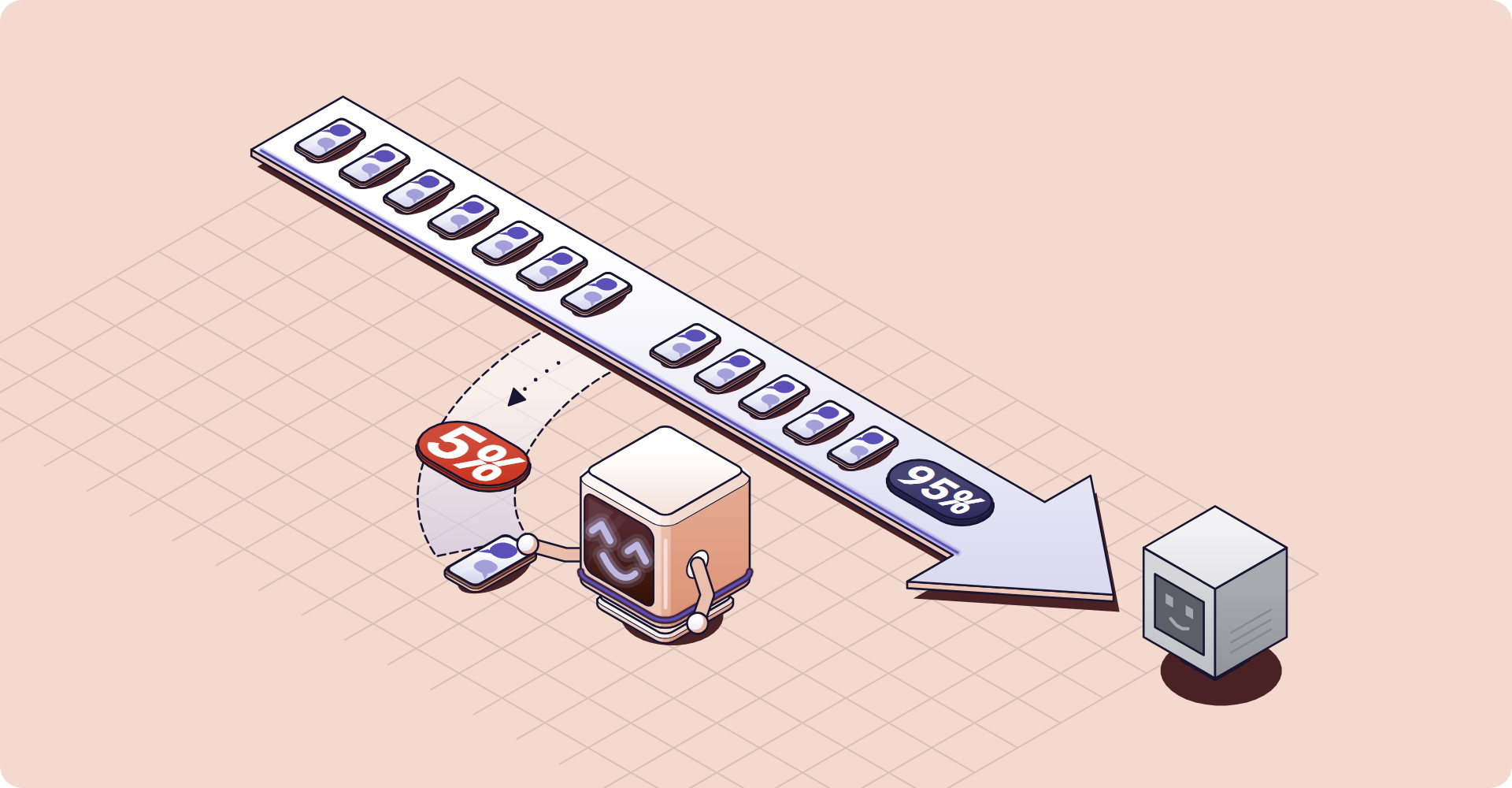
LIVE TRAFFIC SPLIT: The new bot gets one conversation in twenty Any mistake it makes stays in that slice
World App's new support bot went out to 5% of live support traffic first, one in every twenty people who wrote in. That number came from asking who gets hurt if the bot is wrong, and how many of them at once. Every conversation started with a fraud check on the person's account, whatever they had written in about, in an app with about 40 million users. If that logic had a problem, it could treat honest people as fraud, and at full traffic every person who wrote in would run into it on the same day, with support and the fraud team cleaning up behind it. We also had no way to test the fraud flows before launch, so 5% of live traffic became the test environment.
Everyone else stayed on the old bot, which finished about 55% of its conversations without handing them to a person. That share is called containment. The new bot ramped from 5% of traffic to 60% before it took over all of it, and its containment improved to a stable 82%.
Every conversation started with a fraud check
I designed all of the bot's fraud logic. People who wanted to report fraud had their own report-an-issue flows, but the check every conversation went through first was about the person's own account. Machine-learning rules watched account activity and set fraud statuses and flags, using signals like device IDs, IP addresses, geolocation and transaction monitoring, with every check held to global and local law. The bot didn't score anyone for fraud. Before it answered anything, it looked up the statuses and flags on the account and used them to decide whether the person had been blocked correctly and where they should go next.
Some kinds of flagged activity meant the person never reached support at all. Others went to the fraud team on the support side for a manual review of the account. The hardest identity fraud stayed with the machine-learning rules: phone farms, or people who verified and then sold their phone, where one person or a ring of fraudsters ends up controlling many devices. The rules tried to catch that and put a block flag on the account that stopped app activity.
That division of work is the one I'd want in any bot that touches money or identity. Scoring account activity for fraud is probabilistic, and it belongs with models built for it. Reading the result and routing the person should be deterministic, so the same flags send someone down the same path every time and you can explain afterward why they went there.
Live traffic was the only test environment
The new bot was a rebuild on Zendesk's advanced AI agent, which was new at the time. We had to ramp up on it, learn how it differed from what we had, and train a team to handle the bot, and the first version took months. That was longer than I wanted, so I took the build over myself and designed about 45 conversation flows, each built around one of the top reasons people contacted support. Testing them was the harder problem. The fraud flows couldn't be properly tested without real user data, and at the time we had no way to simulate those users in staging, the test copy where changes get tried before customers see them.
So it went out on live traffic as an A/B/C split test, with the old bot as one of the three arms. All three saw the same people on the same days, so a difference in containment between them came from the bot design, not from timing or a shift in what people were writing in about. Zendesk had no native way to split traffic between bots, so I ran the split with feature flags in PostHog, switches that decide which users get which version. Before each ramp I gave cross-functional teams a heads-up so they could flag anything odd, and the new bot went from 5% of live traffic to 60% before I moved everyone over.
What a few hundred live conversations changed
Once live data came in, I read a few hundred conversations and redesigned the bot in a sprint of a little under two weeks, ramping the split the whole time. The redesign reworked the fraud logic too and cut false positives, the people the checks treated as fraud who weren't. I only have an estimate of how many, so the number stays off this page. On day one of the redesign, containment went from 55% to 65%. By the end of the sprint it was at 88%, and I cut traffic to the old bot and moved everyone over.
That pace only worked because each fix went out to a slice of live traffic, and within days the next batch of conversations showed whether it had worked. After the cutover, containment peaked at 92%, moved up and down for a few weeks, and about a month in settled at a stable 82%. The month-in number is the one I'd ask a vendor for if they pitched me a bot, along with how they kept people from getting trapped on the way there.
After the cutover, containment peaked at 92%, then settled at a stable 82%
Containment: conversations finished without handing them to a person
WORLD APP'S SUPPORT BOT ROLLOUT. NOT TO TIME SCALE
Two asks for a human gets a human
Containment counts the conversations that end without a person stepping in, so a bot can push the number up by being hard to get past. Someone who loops through the bot with no easy way to reach a human, and eventually gives up, counts as contained. How many attempts it should take to reach a person is a decision for the business as a whole, but I strongly believe that someone who asks for a human twice should get one. I build the first ask as a clarifying step: the bot has them explain the issue and why they want a person, then either matches a predefined flow for that case or gives an agentic answer from the help center. If they ask again, they go to a human.
People who never ask get a way out too. After someone has searched the help center through the bot three times without asking for a human, the bot proactively offers them one. Every knowledge answer also asks whether it was helpful, and those yes and no answers drive knowledge curation and improvements as part of a bot QA and content QA program. They're a quality signal containment can't give you, because they come from the people the bot was answering.
I want those exits deterministic: two asks, three searches, the same rule for everyone. The help-center answers are the probabilistic part of the bot and they will sometimes miss, so a person's way out shouldn't depend on how the model reads them that day. It's the same question as the 5% slice, asked about one person instead of a whole user base: if the bot is wrong for them, how long are they stuck with it before a human takes over?
Two asks, three searches, the same rule for everyone
HOW I BUILD ESCALATION INTO A SUPPORT BOT
Whether to stage, and how slowly, is a call about risk appetite
I staged this one to keep the risk off users and off the normal rhythm of support operations. The case for it was fraud checks on every conversation, about 40 million users, and fraud flows nobody could test before launch. Take fraud out of it and the math changes. With no fraud impact at all, the relative risk is low, and the whole A/B approach might not be needed. I'd still run a split test in that spot, but with a relatively small audience and a bigger appetite for risk, you might be fine skipping it.
Go the other way and I'd slow down. If your customers are a small set of high-net-worth clients, you want a staggered release, and probably a slower one than mine. Turn it on for 5% for a day, cut it off, analyze that traffic and make your changes, then turn it back on.
Take fraud out of it and the math changes; go the other way and I'd slow down
WORLD APP'S ROLLOUT; THE OTHER TWO LANES ARE HOW I'D STAGE THEM. NOT TO TIME SCALE
None of this is special to support bots. Say finance turns on an automation that matches and pays invoices, legal tries AI on first-pass contract review, or engineering swaps the model under an agent that already works. Each of those is a rollout, and each can go to all of the work at once or to a slice of it first.
There are a lot of ways to approach this, and picking one is a strategic and tactical call about how much risk the business is willing to carry. Making it well takes knowing the system and the business at the same time, and I weigh three things. What's the worst it can do to a customer, an account or the books when it's wrong? How many people or records does it touch on day one? And how much of a bad day can the business absorb right now?
That last question is where situational awareness comes in, because the answer changes with the calendar. A rollout that's fine in a quiet month is a bad bet in a launch week, while the support queue is already behind, or while the fraud team is buried in something else. If the answer to the first question involves money, identity, a fraud flag or a legal obligation, I start small, ramp only after reading what the last slice did, and keep the feature flag that sends everyone back to the old version where I can reach it.
For a support bot, the Support AI Agent Launch is built this way, with fraud routing, escalation rules and a staged rollout on live traffic, on the help desk you already pay for (Zendesk, for now).
Services
- Is your company paying for AI that hasn't changed how the work gets done?
- Is your bot handing more conversations to agents than the vendor promised?
- Is your AI wish list growing faster than anyone has time to build it?
- Are you paying for more AI seats than your team actually uses?
- Is the bot you launched last quarter still giving last quarter's answers?
Is your company paying for AI that hasn't changed how the work gets done?