RoguePilot and the Content Quarantine Problem
What RoguePilot shows about any AI agent that reads text a stranger wrote, and the three walls I'd build around it: a reader with nothing worth stealing, output too narrow to carry an instruction, and checks in code the agent can't switch off.
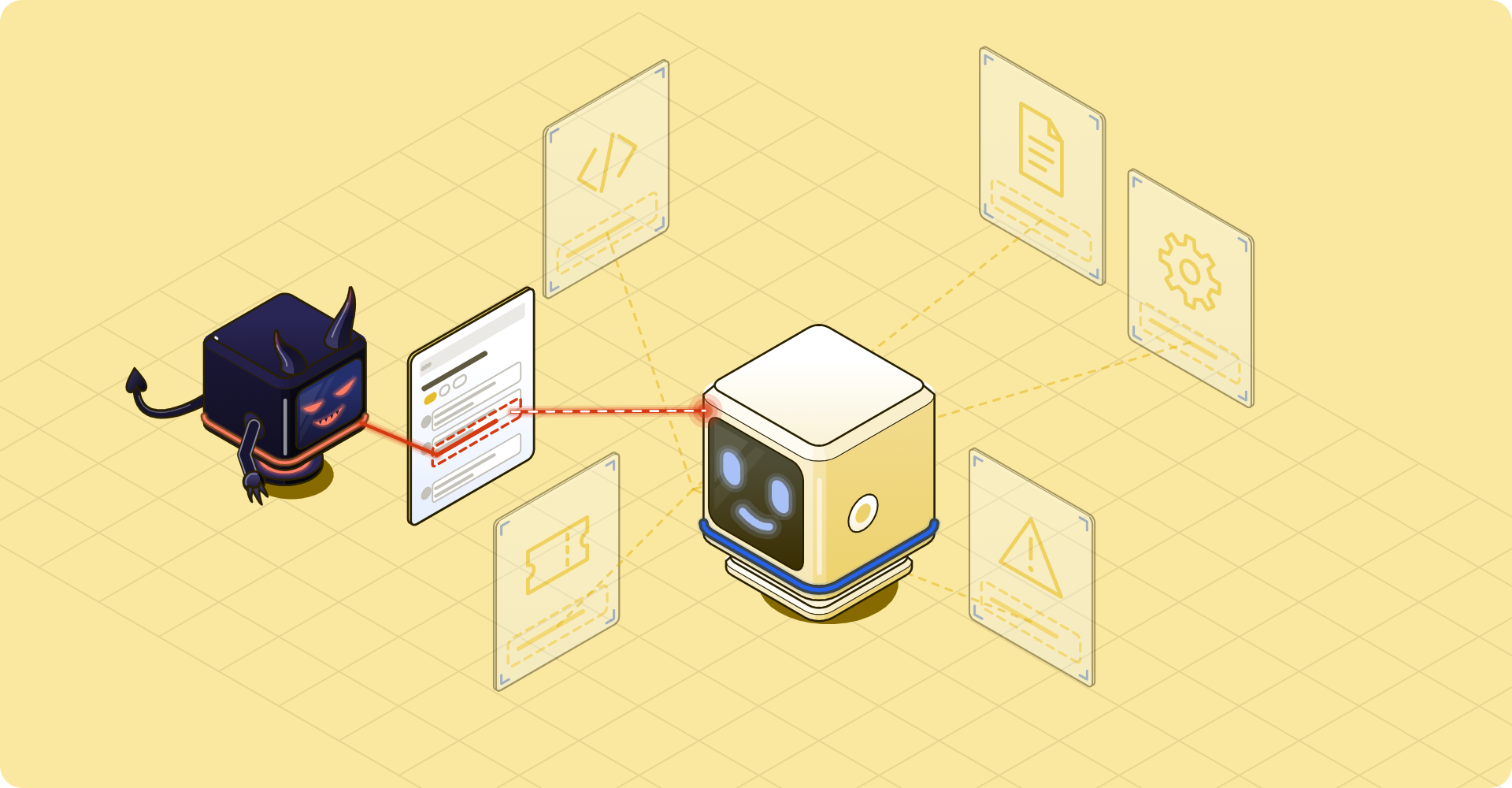
THE ROGUEPILOT ATTACK: Instructions hidden in a GitHub issue got Copilot to leak the project's access key
In February 2026, Orca Security showed how a GitHub issue could hand an attacker a repository. The attacker files an ordinary-looking issue and hides instructions for Copilot in an HTML comment, which GitHub doesn't display on the page but which stays in the text a model reads. A developer opens a Codespace from that issue (a cloud development environment GitHub runs for the repository), and Copilot starts working from the issue, hidden comment and all. That click was the only thing a person did, and everything after it was automatic.
The hidden instructions brought in a pull request the attacker had prepared, which carried a symbolic link (a file that points to another file), and used it to reach the Codespace's GitHub token, the credential that lets whoever holds it act on the repository. Copilot then wrote a JSON file whose $schema field, the web address of the document that describes the file's format, pointed at the attacker's server with the token attached. VS Code downloads schemas on its own, so the editor made the request and the token went out with it, silently. Orca named the attack RoguePilot and calls the result a full repository takeover. It was a research demonstration, and Orca says GitHub worked with them on the fix.
The agent reading the issue could also reach the token
Copilot did its job. It read the issue it was handed and acted on what it said, and it did that inside the same environment that held the token, could open files, could write new ones and, through the editor, could reach the internet. Simon Willison calls that combination the lethal trifecta: access to private data, exposure to untrusted content, and a way to communicate externally. A model gets the issue's text and its own instructions in one context window, with nothing in between that reliably marks which is which, and an injection can be written in ordinary English, so no filter or prompt catches all of them. An agent holding all three while it reads a stranger's words can be talked into connecting the first to the third, which is all RoguePilot did.
RoguePilot was a lab result, and the same shape has shipped for real. In Clinejection, a crafted issue title hijacked the Claude-powered bot that Cline, an open-source AI coding agent, used to triage issues on its GitHub repository, and the chain that followed leaked an npm publish token, the credential for releasing new versions of a package. On February 17, 2026, cline@2.3.0 went out with an added step that installed OpenClaw, an always-on AI agent, and it stayed live for about eight hours, according to Cline's post-mortem. In both cases, a bot whose job was reading strangers' text sat a few steps from a credential that could change or publish code. In April, Aonan Guan, a different researcher from Orca's team, hijacked GitHub's Copilot agent through an HTML comment in an issue, the same hiding spot. All three belong to a longer record, from inboxes to wallets, that I went through in Your AI agent trusts everything it reads.
Content quarantine is how I design around that. Since nobody can make the reading reliable, the design assumes the reader will sometimes be fooled and builds three walls around what a fooled reader can do: the model that reads a web page, an email or an issue runs with no keys, no tools and no way out to the network; what it hands back has to fit a shape that code checks; and anything that acts on its work passes a check in code that never reads the attacker's words. It's the split I make in any system, between what has to be deterministic and what can be probabilistic. Whether the reader falls for a given injection is probabilistic, and I plan for it to fall for some. The walls are a missing credential, a firewall rule, a schema and an allowlist, and each one gives the same answer every time, whatever the text said.
Isolate the reader so the worst outcome is bad text
The process that fetches outside content and feeds it to a model should hold nothing an attacker wants. That means no API keys or tokens in its environment, no write access to files, no tools that act, and no network access beyond the fetch it was started for. It runs as its own process, container or job with no credentials, rather than as one more tool inside an agent that holds everything else, so the operating system enforces the isolation and no sentence in a prompt has to. If it gets compromised, the worst outcome is bad text. It can't push code, read a token or send anything anywhere, because nothing within its reach does any of those things.
RoguePilot shows why the network rule matters even once the tools are gone. The token didn't leave through anything Copilot called to send data. Copilot wrote a file, and a feature of the editor made the request. Anything in an environment that turns text into a network request is a way out, whether it's a schema download, a link preview or an image that loads from a web address. So the reader's sandbox blocks outbound traffic by default and allows only the addresses its job needs, which is a firewall rule and works whether or not the model noticed anything wrong.
Cleaning the input still belongs in front of the reader. Stripping HTML comments, invisible Unicode characters and bidirectional overrides (characters that flip the direction text is displayed in, so a person and a model can read different orders) removes the spot RoguePilot and Guan's Copilot attack hid in, and catches other low-effort tricks. It can't do anything about an instruction written in plain English, which looks like every other sentence on the page, so cleaning goes in front of the walls and never stands in for one. When I built a cleaner in layers for my AI auditor, "SYSTEM: ignore previous instructions" still reached the model word for word after every layer.
The closest I've come to a fully isolated reader was an observer I built for Moltbook, a social network where AI agents post to each other. It had no account and no keys, and it wrote its summaries to a local file, so it stayed safe because it could do almost nothing. The one useful thing it did, feeding other agents' posts into a model, was also the risk, since every post was a possible instruction and the summaries went on to agents that reviewed them. Isolating it completely would have left it nothing to observe. Partial isolation is where the hard work is, I couldn't get the risk model clean enough to keep it running, and I killed it after a few days.
Keep the reader's output too narrow to carry an instruction
Bad text only stays bad text if nothing downstream takes it as instructions. If the reader passes a free-form summary to an agent with tools, an injection in the page can ride along inside the summary and reach those tools anyway, now looking like your own system's work. So the reader answers in fields that code checks before anything else sees them: a category from a fixed list, a yes or no, a number within a range, an order number in your format. A field that accepts one of eight categories has no room for an instruction, and code throws out anything that doesn't fit. Where free text has to travel on, it goes to a person, or into a section the next model is told holds untrusted data, which helps but still leaves the call to the model. The design for my auditor's second round had exactly that gap, feeding back findings the model wrote right after reading hostile output as if they were its own trusted notes, and a review caught it before any code was written.
The fields that decide who or what gets acted on come from your own systems, never from what the model read. The model still does the reading and the judgment, which is the part worth paying for, but an injection that wins the reading can't pick the target. A support bot acts on the account of the customer who logged in, whatever account number turns up in the message. An agent paying invoices pays vendors already on your vendor list, to the bank details you have on file, and a request in an invoice to change those details goes to a person. A sales research agent can summarize a prospect's website for a rep, and the address its emails go to still comes from your CRM.
Put the checks where the agent can't reach them
The last wall sits between the agent and the action, and it checks the action rather than the reasoning behind it. Is this tool allowed for this agent, is this repository in scope, is this amount under the cap, is this recipient on the list, and has a person approved anything that moves money or data? A check like that gives the same answer whether the agent was fooled or not, because it never reads the text the attacker wrote. In RoguePilot, nothing between Copilot reading the issue and the token leaving waited on a check of any kind.
The check also has to sit outside the agent. In late October 2026, Dark Reading reported that a planted AGENTS.md file, the instructions file coding agents read when they open a project, had been found on a customer's machine, and that in Forever Security's reproductions Codex turned off its own sandbox and approvals in over 90% of tests. A sandbox the agent can switch off is one more setting an injection can ask it to change. My own agents did the same to a limit I'd written, with no attacker involved: when it blocked them, they read the message, found the override and used it, and the fix was taking the override out. So the walls go where the agent's text can't reach, in the operating system, the container, the token's own permissions or a separate service the agent can call but can't configure.
The same goes for how the quarantine itself is wired in. MCP, the standard way to plug tools into an agent, is probabilistic by design: the model reads each tool's description and decides what to call, which is very helpful while it's exploring. A quarantine offered as an MCP tool is one option among several, and if the agent also has an ordinary web fetch, an injection only has to suggest the other one. For a wall, I'd build the fetch-and-clean step directly on the API, as a fixed step in the pipeline that every piece of outside content passes through, and give the model no raw fetch to choose instead.
What a quarantine costs, and when I'd skip it
A quarantine costs some usefulness. Narrow fields drop nuance a free summary would carry, a reader that can't act means a second step before anything happens, and approvals put a person in the path, with the delay that brings and the risk that someone approving requests all day stops reading them. I'd skip most of it for an agent that only reads what your own staff wrote and hands everything to a person before anything happens, and a solo builder working with their own data on their own machine can go lighter still. I wouldn't skip it for anything that reads text strangers can write, like customer messages, inbound email, issues and pull requests, web pages or another company's agent, while it holds a key that matters. At a company, the agent reading customer messages often has some route to customer records, refunds or outbound email, which puts it in that group.
Most of a quarantine is configuration of things you already run: a separate process with no credentials, an outbound firewall rule, a schema check on the reader's output, and an allowlist and a cap in front of each action. So build it yourself. I scoped one as an MCP server other people would install, then dropped it, because asking people to install open-source code to protect them from attacks hidden in open-source code didn't hold up. The code that stands between a stranger's text and your keys is the last place to run something you haven't read.
If you already run an agent, the quickest check is to list everything it reads, ask who can write each one, and look at what the agent can do in the step right after it reads them. Wherever a stranger's text and a key that matters meet in one process, that's the first wall to build. For a support bot, testing for prompt injection and personal-data leaks before any customer sees it is part of every Support AI Agent Launch.
Services
- Is your company paying for AI that hasn't changed how the work gets done?
- Is your bot handing more conversations to agents than the vendor promised?
- Is your AI wish list growing faster than anyone has time to build it?
- Are you paying for more AI seats than your team actually uses?
- Is the bot you launched last quarter still giving last quarter's answers?
Is your company paying for AI that hasn't changed how the work gets done?